Cartel Capers

A blog about cartels, competition and compliance

100 Blawg Honoree
  • Home
  • Bob Connolly
    • Contact
  • Antitrust Resources
  • Enforcement Agencies
  • Whistleblower Blog

Bi-Monthly Criminal Cartel Update–Thursday–Feb 18th

February 16, 2016 by Robert Connolly

I am pleased to announce that GeyerGorey LLP will be hosting the Bi-Monthly Criminal Cartel Update this Thursday, February 18th at 12:30 EST.  The program is a little different this month.  Usually the Update is hosted by one firm with international offices.  GeyerGorey does not have international offices–but we do have friends who do.

The program will be moderated by Hays Gorey, Jr. my partner at GeyerGorey.  I will be reporting on developments in the United States.  My bio is here. Dorothy Hansberry Bieguńska of Hansberry Tomkiel, Warsaw, Poland will be covering matters in Europe.  Hays and I both know Dorothy from the years she worked at the Antitrust Division of the DOJ.  Dorothy has gone on to have a very interesting international career and is a founder of Hansberry Tomkiel, a leading Polish competition law firm.  Masayuki Atsumi, a lawyer at Mori Hamada & Matsumoto, Tokyo, Japan will be covering developments in Asia.  I first got to know Masayuki when he contributed posts to Cartel Capers.  Masayuki is now seconded to Covington & Burling and is stationed in Covington’s DC office.

I hope we can bring you an interesting program and match the usual high quality of these ongoing updates.  You can register here.  The official ABA announcement is below.  [Read more…]
Filed Under: Blog

A Carrot and Stick Approach to Leniency and Compliance Programs

February 12, 2016 by Robert Connolly

Since I attended the International Cartel Workshop program in Tokyo on February 3-5, I’ve been thinking a lot about the Antitrust Division’s policies on a) leniency and b) not awarding credit for preexisting compliance programs.  The two policies were demonstrated very clearly in a well constructed hypothetical dramatization at the Cartel Workshop, complete with mock negotiations between companies and the USDOJ. In the first instance, Company A, arguably the most culpable member of the hypothetical cartel, received leniency.  Meanwhile, the second-in company sought credit for its compliance program, but that plea fell on deaf ears.  A senior executive at the Vice-President level of the company (and a subordinate) were involved in the cartel and the Antitrust Division does not give credit for failed compliance programs.

I don’t think the Antitrust Divison’s policy on compliance programs is logical or good policy.  I wrote an article on this for Law 360: Compliance Thoughts From the International Cartel Workshop.  But, here are a few additional thoughts.

Leniency has been touted by the DOJ as the greatest cartel-busting tool in the enforcers’ arsenal. And leniency has become a bedrock of anti-cartel efforts of competition agencies around the world.  While there are some differences among leniency programs, leniency has been a great American export.  And it works.  Leniency undoubtedly prevents cartels from forming because the risk of detection is too high.  And, leniency destabilizes cartels that do form because of the likelihood that someone is going to break the ranks of secrecy and inform on the cartel.  But, leniency works in part because the incentives to grab the leniency are very high.  A company and its executives who were engaged in illegal activity get a complete pass from prosecution.  There is no requirement that the leniency company disgorge the illegal profits (though it is assumed that those profits will evaporate through private class action litigation).  The leniency company is not put on probation or subject to a compliance monitor.  There is no requirement that culpable executives be fired or at least removed from their current position.  There is not even a requirement that the leniency company engage in any remedial measures to enhance its compliance program.  Many of these ideas to impose some remedial measures on the leniency “winner” have been suggested to the Antitrust Division, but the Division is not in a mood to add any requirements that might give a leniency company even slightly less incentive to come forward.  Leniency works, and the government does not want to mess with success.

Fair enough, but now compare the treatment of the leniency winner with the second-in that seeks some credit for their compliance program, which admittedly has failed. [Read more…]

Filed Under: Blog

Live From Tokyo: The 11th International Cartel Workshop

February 4, 2016 by Robert Connolly

I am at the ABA/IBA International Cartel Worksop in Tokyo.  It is the 11th biennial international cartel workshop–and each workshop is becoming more international.  There are attorneys from 26 countries and enforcers from 12 different countries at this event.   Donald Klawiter and D. Jarrett Arp are the conference co-chairs.  The conference is unique (in my experience) in that most of the panels are interactive demonstrations modeling realistic discussions.  The demonstrations cover a wide range of scenes from: a) a company board of directors being advised of possible options including leniency when cartel conduct is discovered; b) [actual] regulators from seven jurisdictions coordinating their dawn raids/search warrants; c) subsequent discussions among defense counsel about various strategies in seven jurisdictions; and many more.

The glue of the program is a hypothetical cartel that is discovered during a compliance training session and the action, starting with the rush for leniency/amnesty, flows from there.  The hypothetical is very realistic, rich in complexity and factual detail.  There was an actual dramatization video of the February 2013 meeting among competitors where the alleged agreement for the hypothetical was reached.

The realistic hypothetical brought to life the pluses and minuses of the leniency program, which, with minor modifications, has been adopted around the world.  In the hypothetical, when a company (Acme) conducted competition compliance training at a very recently acquired company, (B-Wheels), counsel learned that B-Wheels was involved in a world-wide bicycle wheel price-fixing/market allocation cartel.  The cartel agreement was reached at a private dinner at a trade association event in February 2013. [the key meeting the program created a video tape for].  The President of B-Wheels was the main speaker and strong advocate for the agreement.  One competitor, Chelun Ltd, clearly accepted B-Wheels offer to collude.  A third competitor, Jit-Ho, a recent disruptive entrant into the market, was noncommittal.  Post-meeting prices increased in the market and market shares seemingly aligned with the price/market allocation discussion.  There was other evidence of competitor contact after the initial cartel meeting, but it related to B-Wheel and Chelun.

From the demonstrations, you could see why the leniency program is so effective.  After the discovery of the B-Wheels cartel at a compliance training session, there really was no  other choice for Acme but to seek immunity.  Trying to end the cartel and keep quiet was not an option because one of the other companies, or an individual, would likely approach the government when the cartel ended.   Waiting was too great a risk to take.  The benefits of seeking amnesty/leniency were overwhelming.

[Read more…]

Filed Under: Blog

Competition Law: From Philadelphia to Hong Kong

February 1, 2016 by Robert Connolly

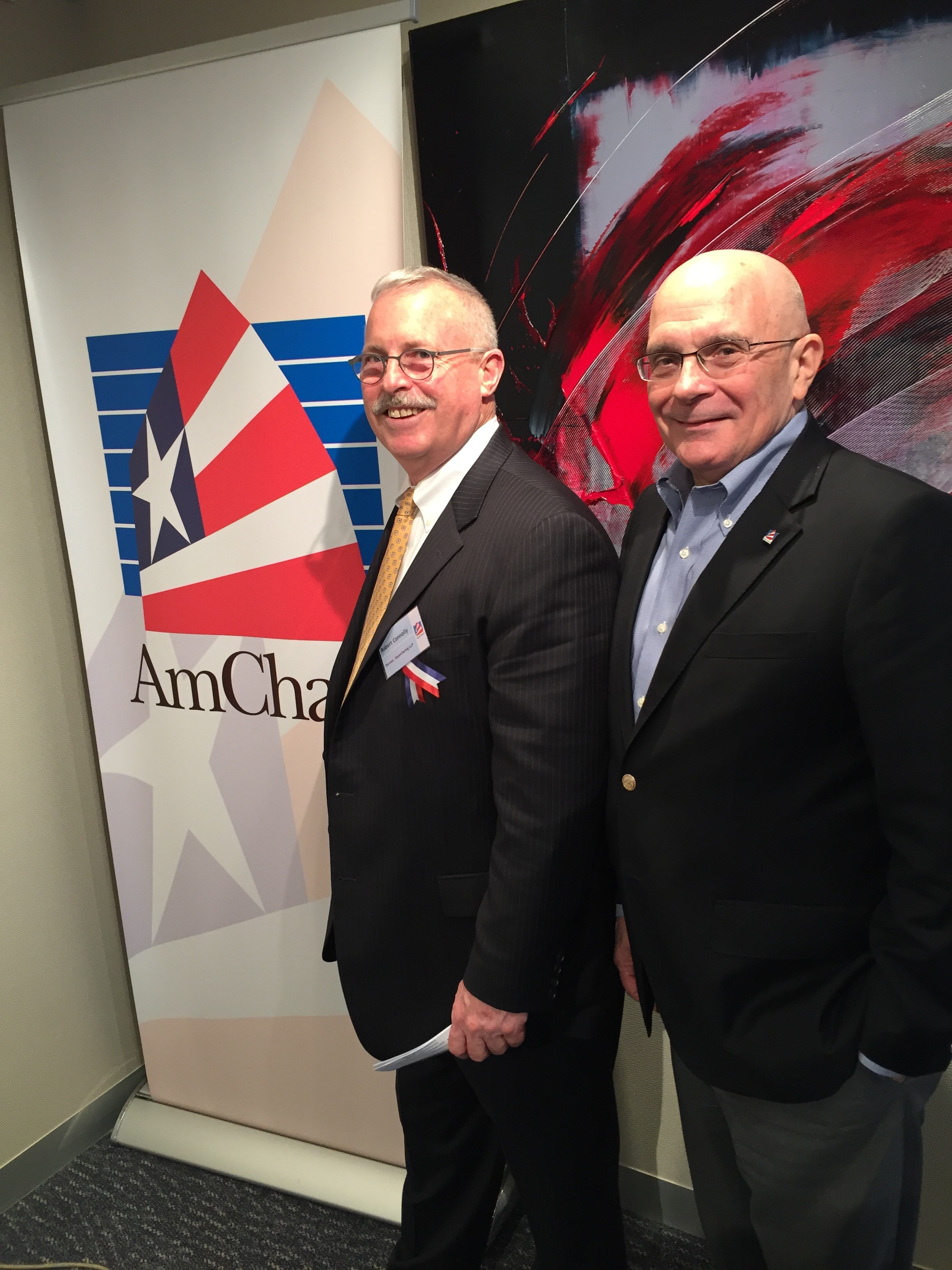
IMG_1003

With Richard R. Vuylsteke, President, The American Chamber of Commerce in Hong Kong (AmCham).

I had a most interesting luncheon today at the American Chamber of Commerce in Hong Kong.  This very active organization sponsors many programs and I was honored to be part of a panel on Trade Policy with a focus on competition law and the Trans-Pacific Partnership Agreement (“TPP”).  I was fortunate to learn much from the two other panelists, Professor Bryan Mercurio, Professor and Vice Chancellor’s Outstanding Fellow of the Faculty of Law, Chinese University, Hong Kong, and Brian Bedell, Consul, Economic Affairs U.S. Consulate General, Hong Kong.  Their breadth of knowledge about economic activity in Asia was very interesting, as well as was their comments on the TPP.

My contribution was comparatively modest, but I was delighted, and a bit incredulous, to be part of the panel.  When I started as baby prosecutor in the Antitrust Division, US Dept. of Justice many years ago, my territory was basically Pennsylvania and half of New Jersey.  (And if we wandered into the northern part of New Jersey, the Chief of the New York office, the great Ralph Giordano, would be on the phone in a New York minute.  We protected our [legal] territories with great zeal, though thankfully with only verbal assaults.)  I digress with fond memories, but by the time I left the Philadelphia office as Chief in 2013, our work was primarily international cartels.  And one of those cartels was the parcel tanker ocean shipping cartel prosecution that I led, so it was interesting to talk a little about that to the Transportation and Logistics committee of AmCham, Hong Kong.

Transportation in various forms has been a frequent target of antitrust prosecutions, and not just by the US Dept. of Justice, but also by the EU, Korea, Brazil and many other jurisdictions.  Many modes of transportation tend to be in oligopolistic industries where collusion is possible and the lure of profits (or, as is often the case–to try to stop the bleeding of price wars) provides temptation.  Additionally, legitimate joint venture agreements, and industry wide exemptions are common, because there are pro-competitive efficiencies to be gained by agreements like code sharing, so competitors are in contact with each other talking about grey area items such as pricing, surcharges and customers.  The road (or flight or shipping lane) from a legitimate joint venture or an approved exemption to illegal cartel activity can sometimes be crossed without due concern for the consequences.

And the consequences are real.  The United States is the leader in imposing prison sentences for price-fixing/market allocation/bid rigging and with extradition treaties and Interpol Red Notices, the reach of the US antitrust laws is global.  But, other jurisdictions around the world have a seat at the cartel enforcement table and impose substantial corporate fines for cartels that effect their consumers.  Huge markets such as China and India have also more recently developed significant, sophisticated competition commissions and enforcement agendas.

We discussed that Hong Kong very recently began enforcing its new Competition Ordinance, which I discussed in a prior post here.  And the Hong Kong Competition Commission is currently considering a block exemption request submitted by the Hong Kong Shipping Association, also covered in an earlier post here.  One of the items we discussed was the pro-competitive, efficiency enhancing benefits that can come result from certain types of competitor cooperation.  And the cooperation need not be, and usually isn’t, in the form of an exemption.  Joint ventures can be a from of consumer friendly cooperation.  One of the reasons competition compliance training is important is to understand not just the “That Shall Not’s” but also the “Yes, you can do that.”  Fear of antitrust problems is a legitimate concern, but unwarranted concern shouldn’t chill pro-competitive efforts.

I really enjoyed the Q&A, which continued after lunch.  As further evidence of the global nature of competition law, I am now on my way to Tokyo for the American Bar Association International Cartel Workshop.  I wish I could have spent a little more time in Hong Kong.  Beautiful city.

Thanks for reading.

PS.  The nature of my talk and this blog post was general and not intended as legal advice.  While competition law has sprouted to over 100 competition agencies around the world, and there is more commonality among competition laws then there are differences, some of those differences are very significant.

Filed Under: Blog

Sovereign Compulsion Defense Blocks Chinese Bauxite Price Fixing Class Action

January 27, 2016 by Robert Connolly

Resco Products, Inc., individually and as a class representative, brought a claim against two Chinese bauxite producers:  Bosai Minerals Group and CMP Tianjin Co.  Plaintiffs alleged a conspiracy to fix the price and limit the supply of refractory grade bauxite in violation of the Sherman Act, 15 U.S.C. § 1.  The Court granted the defendants’ motion for summary judgment finding (1) that the Chinese government set the quotas for bauxite export; and (2) that the plaintiffs proved only parallel pricing–not an agreement to fix the price of bauxite.

Since at least the mid-1980s, a substantial percentage of the “refractory grade” bauxite consumed throughout the world has been exported from China.  Defendants are two of China’s largest refractory grade bauxite exporters.   Plaintiff’s § 1 claim was based on its assertion that “[d]efendants and their co- conspirators colluded to fix export prices and quotas for bauxite from 2003 to 2009.”

The evidence showed that there were discussions of and agreements reached on bauxite quotas at Bauxite Branch [trade association] meetings in China.  The evidence appeared to indicate explicit member participation in a conspiracy to limit output.  The Court found, however, that the Bauxite Branch lacked authority with respect to quotas, so the agreements were merely advisory opinions to the Chinese government of what the quotas should be.  The Court found that since at least 2001, MOFCOM (Ministry of Commerce) has been “responsible for deciding and announcing the types and the total quota quantity of commodities subject to bidding,” not the trade association or its members.  The Chinese government, not the defendants, set the quotas.  These facts established a successful “sovereign compulsion” defense.

Plaintiff’s also alleged that the defendants fixed the export price of bauxite, but the Court found that plaintiffs only proved parallel pricing. Plaintiffs failed to establish sufficient “plus” factors from which a jury could infer an agreement.  The Court’s opinion has a thorough discussion of the plus factors needed in the Third Circuit to permit an inference of agreement/conspiracy from parallel pricing.

[Note: If I recall the lesson Terry Wilson gave his co-conspirators (on the secretly recorded FBI video tapes) in the ADM/lysine conspiracy, once you fix the quota of exports (as the Chinese government did) you don’t need to fix prices.  The reduced output will drive the price to the supra-compeptive level.  If any conspirator cuts his price, it will only benefit the other conspirator(s) who will gain by selling the remaining volume at a higher price.]

The case is:  RESCO PRODUCTS, INC. v. BOSAI MINERALS GROUP CO., LTD., and CMP TIANJIN CO., LTD., Civil Case 2:06-cv-00235 (W.D. Pa. filed 01/25/16) (Judge Joy Flowers Conti).

Filed Under: Blog

Hong Kong Shipping Association Seeks Liner Exemption

January 25, 2016 by Robert Connolly

The Hong Kong Liner Shipping Association has submitted to the Hong Kong Competition Commission for consideration a block exemption for liner shipping agreements.  The HK Commission gave interested parties until March 24 to comment on the Association’s request. Hong Kong’s new Competition Ordinance, which bans cartel and other anticompetitive agreements, took effect just last month (see blog post Hong Kong Competition Ordinance Takes Effect), and without an exemption would presumably prohibit the types of agreements proposed under the exception request.

In the summary of its application (here), the Hong Kong Shipping Association says it seeks immunity for two types of agreements: (i) voluntary discussion agreements (“VDAs”); and (ii) vessel sharing agreements (“VSAs”). VDAs are commercial agreements between carriers whereby parties exchange and review market data and trade flows, supply/demand forecasts and business trends to better inform business decisions.  They may discuss, develop and agree to recommend voluntary guidelines for rates, charges, service contract or tariff terms and other similar commercial issues. Contracts with shippers are then negotiated and agreed by individual carriers (not the VDA), who may or may not follow the VDA’s guidelines. VDAs bring about: rate stability; service stability; and rate and surcharge transparency, all of which represent efficiencies that benefit customers (and ultimately the wider Hong Kong economy) by enabling better planning and budgeting of long-term shipping costs. VSAs, by contrast, are operational and similar to airline code-sharing agreements, with carriers discussing and agreeing on “technical and operational arrangements relating to the provision of liner shipping services, including the coordination or joint operation of vessel services, and the exchange or charter of vessel space.

The HK Competition Commission is calling for interested parties to submit their views in relation to the application (here). In particular, the Commission said it is seeking comment on experiences with using the two types of agreements in Hong Kong business operations, specific concerns related to either agreement, economic efficiencies related to either and broad market conditions in the industry, “including the state of competition.”  The decision could be critical to the continuation of Hong Kong’s shipping industry, as discussed in this Journal of Commerce article (here).

Liner agreements are common in the shipping industry because cooperation can have pro-competitive efficiency enhancing effects that can benefit customers through increased service and lower prices. The Hong Kong Shipping Association has documented the benefits of, and widespread acceptance of, shipping agreements in the international community (here).  But, even if the liner agreement exemptions are approved, it is critical for the industry to understand that the exemptions are limited to the specific terms of the immunity. Carriers that confer with one another on legal exemptions have to be particularly aware of the limitations of the immunity and the consequences of reaching broader or non-reported agreements.  Over the years, there have been enforcement actions brought against carriers in industries where the agreements reached extended beyond the limited scope of any immunity.  I myself led a prosecution of a worldwide ocean parcel tanker price fixing/customer allocation agreement that ran from at least 1998 into 2002.

More recently, the Antitrust Division of the United States Department of Justice has brought criminal actions against shippers and individuals in the auto roll off carrier industry for industry wide-price fixing. United States prosecutes cartels, include shipping cartels, as crimes, punishable by huge fines and jail sentences for individuals.  An employee of Japan-based NYK pled guilty and was sentenced to 15 months in a U.S. prison for his involvement in a conspiracy to fix prices, allocate customers and rig bids of international ocean shipping services for roll-on, roll-off cargo, such as cars and trucks, to and from the United States and elsewhere.  This was the third case against an individual in the Antitrust Division’s ocean shipping investigation, and the first against an individual from NYK.  Three corporations have agreed to plead guilty and to pay criminal fines totaling more than $136 million, including NYK, which has agreed to pay a criminal fine of $59.4 million.  See the DOJ press release here.   The investigation by the US DOJ has spurred enforcement actions by several other jurisdictions including the EU, China, South Africa and others, though the US is usually alone in seeking jail for individuals.  Here is a blog post I did on the huge fines recently imposed in China–China Fines 7 Shipping Companies $65 Million.

Briefly put, immunity for two carriers to discuss and agree on code sharing for a specific route is not a license for an industry wide agreement to fix prices. Or, on non-legal terms as my Mom used to say, “I said you could borrow the car; I didn’t say you could drive to Las Vegas.” [She said that to my brother; I was an angel.]

On a related note, I will be giving a talk before the American Chamber of Commerce in Hong Kong as part of a trade policy panel on February 1, 2016 (here). The topic will include how the US goes about prosecuting international cartels and how Hong Kong’s new Competition Commission begin its enforcement efforts.

Thanks for reading.

Filed Under: Blog

International Cartel Workshop–Tokyo, February 3-5

January 22, 2016 by Robert Connolly

I will be attending the International Cartel Worksop in Tokyo from February 3-5.  The workshop centers around a hypothetical international cartel investigation with enactments of the many behind the scenes interactions such as discussions among various enforcement agencies plan simultaneous dawn raids, the decision of in-house and outside counsel about whether to seek amnesty/leniency and the tough choices that counsel for individual defendants/targets face in deciding whether to cooperate.  The roles on the panels are played by actual enforcers and counsel experienced in this area.  I will be portraying a target of the investigation discussing options with my counsel.  There will also be mock courtroom proceedings. (Hopefully one where my innocence is established!)

I’ve reposted a message below from Roxann Henry, Chair of the ABA Antitrust Section with a link to the program in case you are interested;

**********************************************************************

It’s not too late to register for the International Cartel Workshop to be held in Tokyo on February 3-5, 2016. With over 300 already registered, the participation of top enforcers from jurisdictions around the globe — including the US, EC, Canada, Brazil, and Japan — and mock courtroom proceedings in both civil and criminal cases before a US federal judge, Tokyo will abound with new insights and fantastic networking. A special, one-time only 50% discount for in-house legal departments has driven attendance from the corporate world in Japan and brought new members to the ABA and the Section. (The least expensive way for in-house legal department members from outside the US to register is to join the ABA at the international rate and the Section, then take advantage of the Section rate.) If your practice involves cartels, don’t miss this event!

As the Section year nears its halfway mark, I once again want to thank everyone for their work on behalf of the Section.

Roxann Henry, Chair

International Cartel Workshop 

Filed Under: Blog

I Know this Looks Bad, But…..

January 13, 2016 by Robert Connolly

When I was a kid, there were times when it looked like I was in big trouble, but was able to talk my way out of it.  “Mom, I know this looks bad, but ….”  (Probably I did do it, but it was good practice for being a lawyer.)  There are times when even the most ethical companies can “look” like they may have violated the antitrust laws.  And it may not be as simple as explaining to Mom why things aren’t the way they look.  That “splaining” may take years of costly litigation, even for a defendant that hasn’t done anything wrong.  That is why antitrust/competition law compliance training is important, even for companies that have the highest ethical standards.  Not only is it important to not violate the law, but it is import to know how to communicate the pro-competitive merits of actions in the marketplace and to document why decisions were made.

Let me give one example.  In a commodity market with few sellers, it is natural that prices are going to be similar, if not identical.  If a company’s pricing is above the market in a commodity, their sales will suffer.  But, there is a thin line between “conscious parallelism” and price fixing.  A communication to customers such as this may be the hook to suggest sellers have crossed the line:  “The X industry has not been profitable and as of March 1 our prices will increase 5%.  This is in line with the increases of the other producers in the industry who are also going up.”  The company may be trying to communicate that they are only doing what others are doing to “stay competitive.”  But, referring to “industry pricing” gives the hint of collusion–enough of a hint to possibly draw an antitrust suit.  Much better to simply write:  “We have experienced increases in the cost of several major inputs.  Regrettably, we find it necessary to increase our prices 5% as of March 1.”  And there should be a document in the file explaining the need for the price increase.

To be clear, the first email does not establish that price fixing has occurred.  But, it may be enough,along with other evidence,  to give potential plaintiffs enough to file a case and result in a settlement to avoid costly litigation.  And, while no policies can guarantee a company will never be sued, an educated sales force will greatly lessen that likelihood.

The above is just one example. On January 19, 2016 from 1:00 to 2:15 pm I will be giving a presentation for Clear Law Institute on “Avoiding the Creation of “Hot” Antitrust Documents.”  I will talk about risk assessment for antitrust lawsuits and how to avoid creating the appearance of anticompetitive conduct, while documenting the pro-competitive reasons for activity in the market place.  The announcement/registration for the program is here.   There is a 35% off discount code you can use if you’d like to register: connolly35

Please check it out and see if it might be useful to your organization.   There will be slides that you may want to later  distribute as part of an antitrust compliance program.

Thanks for reading.

Filed Under: Blog

Avinash Amarnath Provides India Update

January 11, 2016 by Robert Connolly

Below is a comprehensive post by Avinash Amarnath, attorney with Vinod Dhall & TT&A, New Delhi, India.  Mr. Amarnath covers several subjects including the new Chair of the Competition Commission of India.

India Update 2016 – Vol I

Hello and a happy new year to all readers. There were a few significant cartel developments towards the end of 2015 in India which I will be covering in this post along with some recent administrative developments.

 New Chairman of CCI appointed

Mr. D. K. Sikri, a former officer of the Indian Administrative Service (IAS) has been appointed by the Government of India as the new Chairman of the Competition Commission of India (CCI). Mr. Sikri succeeds Mr. Ashok Chawla, whose tenure ended on 7 January 2016.

COMPAT sets aside cartel fines against cement companies

The most significant cartel development of 2015 happened to come right at the end. On 11 December 2015, the Competition Appellate Tribunal (COMPAT) set aside an order of the CCI imposing fines amounting to approx. USD 945.4 million on 11 cement companies and their trade association for operating a cartel. The order was set aside on due process grounds and the matter was remitted back to the CCI for a fresh hearing and decision. The cement companies, amongst others, argued before the COMPAT that the CCI’s order violated the rules of natural justice and in particular, the rule that he who hears must decide as the Chairperson of the CCI who did not attend the oral hearings of the parties had participated in the decision making process by signing the order. The CCI’s position was that it only performs administrative functions and therefore, the rules of natural justice should not be applied to it in a strict manner. Further, the CCI argued that no real prejudice had been caused to the parties as a result of this alleged violation of the rules of natural justice.

The COMPAT observed that the basic question to be determined was whether the CCI is merely an administrative body or whether the CCI performs quasi-judicial functions and is therefore, bound by the rules of natural justice. After an extensive review and discussion on the powers of the CCI under the Indian Competition Act, 2002 (Competition Act), the procedure for dealing with a case and several case law of the Supreme Court of India on whether the rules of natural justice apply to administrative and quasi-judicial actions, the COMPAT concluded that it was evident that the CCI performed quasi-judicial functions while hearing and disposing off antitrust cases. Accordingly, the CCI was bound by the rules of natural justice including the rule that he who hears must decide. The COMPAT also rejected the argument of the CCI that no prejudice was caused to the parties as a result of this lapse by distinguishing the facts of this case from other precedents relied on by the CCI. Further, the COMPAT found that actual prejudice had been caused by this lapse as the Chairperson had lent his signature to the final order without having heard the various substantive arguments raised by the parties during oral hearing. In any event, it would be very difficult to judge whether prejudice had been caused as it would be impossible to determine the outcome of the case had the Chairperson not participated in the decision making process. Finally, the COMPAT urged the CCI to evolve a comprehensive protocol and lay down guidelines for investigating and hearing a case in consonance with rules of natural justice. [Read more…]

Filed Under: Blog

China Fines 7 Shipping Companies $65 Million

December 28, 2015 by Robert Connolly

Shipping cartels have been a frequent target of prosecution by the Antitrust Division of the United States Department of Justice. The rules around shipping cartels can be confusing because certain joint pricing activity can be legal and there are also exemptions for other cartels. But, as some companies have found out the hard way, there is no blanket exemption for collusive pricing in the shipping industry. Moreover, the number of enforcement agencies jumping in the water of cartel prosecutions is expanding. The United States has had an active shipping cartel investigation with prosecutions in the car carrier shipping business. Now, China has fined seven shipping companies, a total of 407 million yuan ($65 million) for price-fixing in what appears to be the same cartel.

The National Development and Reform Commission (NDRC) oversee the pricing restrictions of the antimonopoly law. In an announcement today, the agency said that for four years the companies colluded to raise rates on shipments of cars, trucks, and construction machinery across five shipping routes, including between China and North America, Latin America and Europe. The cartel targeted “roll-on, roll-off” shipping rates for cars, trucks and construction equipment. These are specialized cargo ships that can carry hundreds of vehicles.

The NDRC imposed fines of four to nine percent of the companies’ 2014 revenues of their related China business. EUKOR Car Carriers Inc. was hit with the largest fine, 284 million yuan ($45 million). At the other end of the spectrum, Nippon Yusen KK (NYK) said it fully cooperated with the probe and was granted immunity from any fine. Besides Eukor’s $45 million penalty, Wallenius Wilhelmsen Logistics, a Swedish-Norwegian company, was fined 45 million yuan ($7.1 million). Mitsui O.S.K. Lines Ltd. was fined 38 million yuan ($6 million). Other companies penalized were Japan’s K Line and Eastern Car Liner Ltd. and Chile’s CSAV and CCNI.CSAV and its roll-on, roll-off shipping unit were fined the smallest amounts of less than $1 million each.

Several years ago when I was with the Antitrust Division, I led an investigation and prosecution of a global parcel tanker cartel.  At the time, I don’t believe China’s cartel enforcement law was enacted. Now, China has become a serious cartel enforcement agency. The NDRC is believed to be active in the current global capacitors cartel investigation. The Chinese have also fined cartel members in the TFT-LCD cartel.

Never Too Late for a Competition Law Compliance Program

Several of the fined companies issued announcements acknowledging the illegal conduct and vowing that the collusion would not recur. The companies stated that they were taking the action seriously and developing and implementing a competition compliance program. Of course, a compliance program is much better when developed before being fined for collusion, but a prosecution is sometimes what it takes to get the issue to be taken seriously by senior management. A compliance program is not only effective at preventing cartel activity, but even if it fails, having executives knowledgeable about competition law is also the best way to be in a position to be the first to qualify for immunity if there is an investigation.

US Still Main Concern for International Cartels

The biggest reason for an international company to have an effective competition law compliance program may be the aggressive international cartel prosecution program of the Antitrust Division of the US Department of Justice. The United States is not shy about prosecuting foreigners for cartel activity that affects the United States. In the United States price-fixing and bid rigging are criminal offenses carrying jail sentences of up to 10 years. And even if a foreign executive thinks he will never be apprehended by the US, being a fugitive on an Interpol Red Notice puts a serious crimp in any travel plans.

In the Chinese investigation NYK got immunity for their cooperation. This was not the case in the United States.  On October 6, 2015, the US Department of Justice announced that three former ocean freight executives have been indicted for participating in the car carrier cartel:

These executives – Yoshiyuki Aoki, Masahiro Kato and Shunichi Kusunose – have been charged with allocating customers and routes, rigging bids and fixing prices for the sale of international ocean shipments of roll-on, roll-off cargo to and from the United States and elsewhere.  The affected cargo included cars, trucks, construction equipment and agricultural equipment.  Aoki, formerly of Kawasaki Kisen Kaisha (K-Line), and Kato and Kusunose, formerly of Nippon Yusen Kabushiki Kaisha (NYK), are among seven executives who have been charged in the investigation so far.  Four have pleaded guilty and been sentenced to prison.  NYK, K-Line and one other company have also pleaded guilty and paid more than $136 million in criminal fines.

If you have any questions about competition law or compliance programs, please feel free to reach out at Robert.connolly@geyergorey.com or on LinkedIn (here)

Thanks for reading.

Filed Under: Blog

  • « Previous Page
  • 1
  • …
  • 21
  • 22
  • 23
  • 24
  • 25
  • …
  • 37
  • Next Page »

Search this site

The US Supreme Court has called cartels "the supreme evil of antitrust." Price fixing and bid rigging may not be all that evil as far as supreme evils go, but an individual can get 10 years in jail and corporations can be fined hundreds of millions of dollars. This blog will provide news, insight and analysis of the world of cartels based on the many years my colleagues and I have as former feds with the Antitrust Division, USDOJ.

© Copyright 2014 Cartel Capers · All Rights Reserved