Cartel Capers

A blog about cartels, competition and compliance

100 Blawg Honoree
  • Home
  • Bob Connolly
    • Contact
  • Antitrust Resources
  • Enforcement Agencies
  • Whistleblower Blog

Some After Thoughts From An FTAIA Conference

October 16, 2015 by Robert Connolly

I went to a very interesting conference on the FTAIA a few weeks ago.  I’ve been a bit busy so haven’t had a chance to post.  But, FTAIA issues aren’t going to be settled anytime soon, so here goes.

On September 27 I was fortunate to be able to attend the conference Extraterritoriality of Antitrust Law in the US and Abroad: A Hot Issue. The conference was sponsored by George Washington Law School and Concurrences.  Application of the Foreign Trade Antitrust Improvement Act (FTAIA) is indeed a hot issue. And with the capacitors investigation being the next big thing in international cartel enforcement, I boldly predict the FTAIA is going to continue to be a hot issue.

There was a number of interesting panels and insightful discussions at the conference.  Judge Dianne P. Wood, Chief Judge of the US Seventh Circuit Court of Appeals was a terrific choice as the keynote speaker. Before the joining the Court of Appeals, Judge Wood was instrumental in many difference roles in promoting competition law internationally and fostering cooperation among the world’s competition law community. I was in the Antitrust Division when Judge Wood was a Deputy Assistant Attorney General overseeing all international matters.  Judge Wood traced the history of international cartel enforcement and cooperation from when the US had a monopoly, then the US and EU had a duopoly, and now there is at least an oligopoly of cartel enforcement with more nations joining as time passes.

Judge Wood also discussed the fact that the FTAIA is not a subject-matter jurisdiction limitation on the power of the federal courts but a component of the merits of a Sherman Act claim involving nonimport trade or commerce with foreign nations.  The first significant difference is that if application of the FTAIA were a jurisdictional issue it could be raised at any time. If brought to the court’s attention that the court does not have jurisdiction to hear a case, the case must be dismissed.  And the court is the fact-finder.  But as a substantive element of a Sherman Act offense, whether complaint satisfies the FTAIA is decided on a Motion to Dismiss with all inferences drawn in favor of the plaintiff.

Judge Wood also noted that the Seventh and Ninth Circuit have different standards for measuring whether anticompetitive conduct abroad has a direct, substantial and reasonably foreseeable effect on commerce in the United States.  The Ninth Circuit has interpreted the FTAIA requirement of “direct” to mean that the effect on U.S. commerce follow as an “immediate consequence” of the defendant’s conduct. U.S. v. Hui Hsuing, 778 F. 3d 738, 758 (9th Cir. 2014). The Seventh and Second Circuits, on the other hand, have construed the term “direct” in the FTAIA to denote a “reasonably proximate causal nexus.” Motorola Mobility LLC v. AU Optronics Corp., 775 F.3d 816, 819 (7th Cir. Nov. 26, 2014), as amended (Jan. 12, 2015); Lotes Co. v. Hon Hai Precision Indus., 753 F.3d 395, 410 (2d Cir. 2014).  In most cases there may not be a difference in the outcome depending upon what standard is used.  In fact, the Supreme Court declined to take cert. in the Motorola and AU Optronics cases (see prior post here).  But Judge Wood noted that a Supreme Court decision on FTAIA issue would be welcome.   [Read more…]
Filed Under: Blog

Antitrust Division Provides Guidance for an Effective Compliance Program

October 7, 2015 by Robert Connolly

On Sept 16, 2015, The Antitrust Division announced that Kayaba Industry Co. Ltd., dba KYB Corporation (KYB) had agreed to plead guilty and to pay a $62 million criminal fine for its role in a conspiracy to fix the price of shock absorbers installed in cars and motorcycles sold to U.S. consumers.  The plea agreement indicated that KYB would receive credit for instituting an effective compliance program going forward.  The Division had only recently announced that it was possible for a company to get credit for a forward-looking compliance program that change the culture of the company.  This was a big and new step for the Division so there was a great deal of curiosity as to what the company did that the Division considered credit worthy.  Yesterday, the Division filed its sentencing memorandum which gives an outline of the compliance steps that KYB took.

The first thing to note is that the government praised KYB’s cooperation, noting that it cooperated early, the CEO ordered a complete and timely internal investigation, and the company has made employees and documents available that were outside the US.  I would say that early and complete cooperation is probably the most important factor in convincing the government that there has been a change in culture.   But, in the past, that alone would not earn a company any credit for a compliance program.  In its sentencing memorandum, the Division said this about KYB’s compliance efforts:

“KYB’s compliance policy has the hallmarks of an effective compliance policy including direction from top management at the company, training, anonymous reporting, proactive monitoring and auditing, and provided for discipline of employees who violated the policy.” Case: 1:15-cr-00098-MRB Doc #: 21 Filed: 10/05/15.

These steps closely follow the US Sentencing Guidelines outline for an effective compliance and ethics program:  US Sentencing Guidelines, §8B2.1. Effective Compliance and Ethics Program.

At a recent conference, Brent Snyder indicated that more pleas with credit for compliance programs are in the works and will provide a roadmap for what the Division considers an effective compliance programs.  I wrote about that in  a recent blog post (here). [Note:  There was one other plea agreement in the Forex investigation that indicated credit for a compliance program, but that sentencing memorandum has not yet been filed.  Blog post here.]

The credit for a compliance program is a welcome development. But, the current policy raises one question in my mind.  The Division has indicated that it still will not credit “backward looking compliance programs,” that is, compliance programs that have failed.  But, what if KYB had had this compliance program in place all along, yet certain managers violated it?  In that case, the company would not have received credit for the same program?  It will be interesting to see how the Division’s approach to compliance programs evolves.

Thanks for reading.

Filed Under: Blog

Brent Snyder Explains Antitrust Division Approach to Credit for Compliance Programs

September 30, 2015 by Robert Connolly

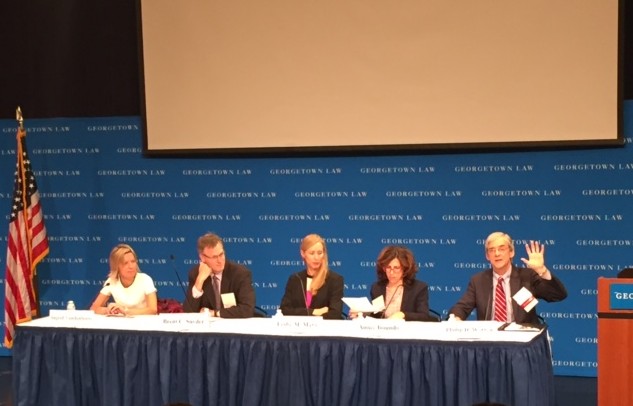
GeorgetownPic

On Tuesday I attended the Global Antitrust Enforcement Symposium at the Georgetown University Law Center.  This is a day long program covering a wide range of global competition law topics including cartels, mergers, abuse of dominance and patents.  This is a great program, but the panel I was most interested in was Collaboration, Conversations and Cartels.  The panel was moderated by Phil Warren and the panelists were Aimee Imundo, Leslie M. Marx, Brent C. Snyder and Ingrid Vandenborre.

I found this panel alone worth the price of admission.  (Though I attended as a guest of Bates White, one of the program sponsors).  The theme of the discussion was that there are many ways that competitors can work together in pro-competitive collaborations, but such collaborations raise increased risk of sliding into anticompetitive activities.  I will write another blog post about the comments of this panel, but for now I want to focus on the comments of Brent Snyder, [Deputy Assistant Attorney General, Antitrust Division, Criminal Enforcement], relating to the Division’s policy on giving (or not giving) credit for compliance programs in criminal case charging decisions and plea negotiations.   [Read more…]

Filed Under: Blog

A Note on Some Upcoming Cartel Related Events

September 14, 2015 by Robert Connolly

There are three upcoming programs that I want to pass along with a brief mention of why I think each is timely and important.   First, on September 22 the Section of Antitrust Law, Cartel and Criminal Practice Committee is hosting a teleconference on extradition.  On September 28, Concurrences is sponsoring a live program on the FTAIA.  Last up, the Georgetown Global Antitrust Symposium is on September 29, 2015. [Read more…]

Filed Under: Blog

Kenneth Davidson: Enforcing Antitrust– Leniency, Consumer Redress, and Disgorgement

September 8, 2015 by Robert Connolly

With his permission, I am gladly reposting a very interesting commentary written by Kenneth M. Davidson, a Senior Fellow at the American Antitrust Institute on September 1, 2015

************************************************************

Over the past 25 years “leniency” policies pioneered by the Antitrust Division of the US Department of Justice have been enormously successful in identifying and prosecuting unlawful cartel behavior.  That success has been replicated by competition agencies in the European Union and elsewhere.  The key to its success has been to offer immunity to the first cartel member that provides the competition agency with evidence that the cartel exists.  The leniency program has led to billions of dollars in fines and imprisonment in the United States of executives of corporations that participated in the cartel.  Notwithstanding these impressive results, I think the effectiveness of competition law needs to be enhanced by a general adoption of policies that require antitrust violators to disgorge all ill-gotten gains earned from anticompetitive actions.

The need for disgorgement is indicated by some perplexing results that have followed the implementation of leniency program.  Greater enforcement of the laws against cartels and other anticompetitive practices ought, in theory, result in the formation of fewer cartels.  Yet enforcement statistics indicate that the number of cartels identified appears to be rising and, even more surprisingly, cartels that have been successfully prosecuted appear to be reforming at an increasing rate.  Professor John Connor, my colleague at the American Antitrust Institute, probably the leading expert on cartel enforcement, published a study in 2010, Recidivism Revealed, which provides data indicating that the rate at which prosecuted violators recreate cartels has continued to rise.

Connor and another AAI colleague, Professor Robert Lande, who have together tracked antitrust penalties and recoveries from private antitrust actions, have suggested the answer to this seeming anomaly is that fines, imprisonment, and private recoveries are not high enough to deter the formation or reformation of cartels.  Their article, Cartels as Rational Business Strategy: Crime Pays, concludes that the formation of illegal cartels will be deterred only if the penalties exceed the anticompetitive profits times the chances of getting caught.  This “optimal deterrence” theory requires that if a company earns a million dollars in unlawful profits and calculates that it has a fifty percent chance of being caught the fine ought to be two million dollars.  Lande and Connor estimate that the total recoveries from public and private antitrust actions is less than 21 percent of the amount needed to deter violations. [Read more…]

Filed Under: Blog

An Update On the Airlines Price Fixing Civil Suits

August 20, 2015 by Robert Connolly

A while back I posted “They Said What?:  Some Compliance Thoughts on the Airline Price Fixing Investigation.”  The post examined how some loose talk by airline executives had led to a federal price-fixing investigation–followed immediately by an avalanche of civil treble damage price-fixing suits.  At a recent trade association meeting, multiple airline executives spoke publicly about their plans to be “disciplined” in their approach to pricing and adding extra flights on popular routes.  Cue up an Antitrust Division investigation, followed in nano seconds by a torrent of private class action treble damage price-fixing cases.  The airline executives may have gotten by unnoticed with their ill-advised comments, except they spoke at a time when the flying public was less than enchanted with the flying experience, including ticket prices that seemed sky-high while the price of fuel was nose diving.  My sense was that it was this environment–a disgruntled public and therefore unhappy Congress folks rather than any hard evidence of price-fixing–that caused the Antitrust Division to decide it was a good idea to at least open an investigation.

I’ve been reading the public news about this investigation and the civil cases and a couple of things caught my eye.  First, a recent report stated that 75 civil suits have now been filed against American, Delta, Southwest and United since July.  The suits tend to be copy cat suits filed by different law firms seeking a good seat (with extra leg room for a fee) at the litigation table when the suits are consolidated.  In the first suit “Plaintiffs allege that defendants illegally signaled to each other how quickly they would add new flights, routes, and extra seats. To keep prices high on fares, it was undesirable for the defendants to increase capacity.”  Other suits are similar.

This avalanche of civil suits doesn’t speak highly of our current class action system.  The airlines have not been convicted of anything, nor have they even been charged by the Antitrust Division.  It is not illegal for a company to try to boost profits by restricting capacity.  Or raising prices.  The key question is whether the action was taken unilaterally (legal) or in collusion with competitors (illegal).  Parallel prices alone are not enough to prove an agreement.  There has to be more.  See  “Getting the Judge to Budge from Conceivable to Plausible Under Twombly.”  But, even if a company is exonerated, the litigation is very expensive; much more so than a good antitrust education/compliance program.

Another interesting fact just out is that airline ticket prices last month saw the largest monthly decline on 20 years.   “Airline fares recorded their steepest monthly decline in 20 years, falling 5.6 percent last month, according to the Bureau of Labor Statistics.”  Does this mean the airlines can can get out from under all the civil suits?  Not likely.  The plaintiffs may spin this as the inevitable collapse of a cartel that couldn’t prop up prices forever in the face of sharply decreased costs.  The airlines will point out that capacity increases that led to the lower prices were in the works for months–at the very time the plaintiffs allege there was collusion.  Both sides will have experts armed with other arguments, analysis and data to support their side.  Whatever the experts say, it won’t come cheaply.  But, right now airfares may, so time to book a flight.

Thanks for reading.

Filed Under: Blog

Recommended: A Paper on Antitrust Informant Rewards

August 11, 2015 by Robert Connolly

Recently I posted a blog item titled:  Should There Be An Antitrust Whistleblower Statute?  I received a comment from Professor Andreas Stephan directing me to a paper he wrote titled: “Is the Korean Innovation of Individual Informant Rewards a Viable Cartel Detection Tool?”  I found the paper very insightful and rich with footnotes.  The paper discussed the view towards antitrust whistleblowers in various jurisdictions, including the United States.  Below is the abstract for Professor Stephan’s paper:

This paper considers whether the use of individual informant rewards or bounties is a viable cartel detection tool. Rewards have the potential to enhance enforcement by revealing infringements that would otherwise go undetected. In order to be effective they should be made available to individuals directly involved in cartels because they may be the only viable source of information. Mere protection from retaliatory measures of employers does not create an adequate incentive to report misbehaviour. The personal costs and risks associated with whistleblowing are so significant that effective rewards may need to amount to a lottery win in order for reporting to be worthwhile. Reward systems pose some dangers to the enforcement system, but these can be managed.

Professor Stephan is a Professor of Competition Law, ESRC Centre for Competition Policy and UEA Law School, University of East Anglia, Norwich NR4 7TJ, UK. Email: a.stephan@uea.ac.uk.   He is also an editor and regular contributor to a Competition Policy blog that I find very informative.  I want to thank Professor Stephan for informing me of his research.

Thanks for reading and check out the Competition Policy blog.

Filed Under: Blog

If Everyone Else Jumped Off A Bridge, Would You Do That Too?

August 4, 2015 by Robert Connolly

The “Everybody Was Doing It” defense didn’t work when I was a kid and it didn’t work for Tom Hayes as his defense in the first Libor rate rigging trial.  But, the most I got upon conviction (summary–without trial) was 14 days grounded.  Mr. Hayes got 14 years in prison.  Ouch!

After a nine-week trial in London and seven days of deliberations, Hayes, a 35-year-old former UBS and Citigroup trader, was found guilty on eight counts of conspiracy to defraud. He was immediately sentenced to 14 years in prison.  Hayes was the first Libor rate rigging individual to face trial (here).

Hayes was charged in the UK with being the “ringleader” of the Libor rate rigging scheme.  Hayes claimed that the rate rigging was industry wide. He also claimed he was “confused about everything,” including what rules may have been broken. He added: “As far as I was concerned, any rules I’d broke were retrospectively being applied. And I wasn’t sure … Libor wasn’t a regulated product. We had no compliance training. No rules were outlined to us.” Hayes didn’t deny he knew he was engaging in “dodgy” activity but pleaded “I knew I was operating in a grey area.  I knew that I probably shouldn’t do it but like I said I was participating in an industry wide practice at UBS that pre-dated my arrival and post-dated my departure.  A full story is here in The Telegraph. [Read more…]

Filed Under: Blog

DOJ to Hire Compliance Expert

July 31, 2015 by Robert Connolly

Here’s a link to a Reuters story by Karen Freifeld reporting that United States Department of Justice is hiring a Compliance Expert. The compliance expert will help evaluate whether to charge corporations that fail to detect and prevent wrongdoing by employees. The DOJ compliance expert will advise whether he believes the company had a robust compliance program or one that was window dressing–or something in between.

A candidate has been reportedly offered the position and is undergoing the background check process. The position is in the Criminal Division of DOJ, which has responsibility for health care, securities and FCPA violations, among others. This development will not directly affect the Antitrust Division, which sometimes has policies different from the Criminal Division. But, the Antitrust Division recently, for the fist time ever, gave credit to a company in a plea agreement for a compliance program. I wrote about this in a previous Cartel Capers post: Senior Antitrust Division Official Comments on Credit for Compliance Programs.  This new compliance position within the DOJ is another important step forward in the recognition by the DOJ of the valuable role played by compliance programs.

Thanks for reading.

Filed Under: Blog

Should There Be an Antitrust Whistleblower Statute?

July 30, 2015 by Robert Connolly

On July 22cd, the Senate passed the Criminal Antitrust Anti-Retaliation Act of 2015. The bill now goes to the House for consideration. If signed into law the Act will create for the first time whistleblower protections for employees who report antitrust violations.  Senator Patrick Leahy and Senator Charles Grassley introduced the bipartisan bill, which provides the following protections and remedies:

Protects employees who report violations of antitrust laws to internally or to the Federal Government from retaliation.

Allows an employee to file a whistleblower retaliation claim with the Department of Labor and also grants de novo review and a jury trial in Federal Court.

Provides employees who suffer retaliation to receive reinstatement, back pay, special damages, attorneys fees and costs.

The full text of the Act is available here.

I did not initially write about the bill for two reasons.  From what I’ve read, there is a less than 50% chance that the bill will pass the House. It is the same bill that has gone to the House to die in the past. If the Act does pass and goes on to the President, I would assume it will be signed.

The other reason I did not write about the Act is because it seems like a pretty ineffective way to encourage whistle blowers to come forward. There is no potential monetary reward for taking the enormous risk of coming forward an exposing a price-fixing or bid rigging crime. There is simply a statute that offers some protection against retaliation if you do come forward.

Still, the passage in the Senate of the Act has gotten me thinking (a monumental accomplishment in itself) about not only should the Anti-Retaliation Act be enacted, but should there also be a whistleblower reward, as there is for SEC violations? As part of the Dodd-Frank reform the SEC established the Office of the Whistleblower. I think simply having such an office indicates a serious desire to encourage whistleblowers. But, on a more material level, the Commission is authorized by Congress to provide monetary awards to eligible individuals who come forward with high-quality original information that leads to a Commission enforcement action in which over $1,000,000 in sanctions is ordered. The range for awards is between 10% and 30% of the money collected. The Whistleblower Office has said “Assistance and information from a whistleblower who knows of possible securities law violations can be among the most powerful weapons in the law enforcement arsenal of the Securities and Exchange Commission.” And Mary Jo White, SEC Chairwoman recently said: “The program, while clearly still developing, has proven to be a game changer.”

Would an “Office of the Whistleblower” be good for the Antitrust Division? (There is still vacant office space in Philadelphia, Atlanta, Dallas and Cleveland :-). The Antitrust Division clearly has not pushed for this tool. One concern expressed by the Antitrust Division while I still worked there was that the provision of a whistleblower bounty would undermine the credibility of a witness. (But, more so than amnesty for an entire organization, or immunity for culpable high level executives?). A whistleblower incentive could also inundate the Division with false leads that would consume valuable resources. (I recall one time when I was Chief in Philadelphia, I received a complaint that the gas companies were fixing prices because everyone went up a nickel on the same day! Well, they did—as a new Pennsylvania tax became effective that day.)  The Division has the experience to size up an irate customer complaining about high prices from an ex-employee who has emails/notes from the cartel meetings he attended. A last concern may be “How will this affect the leniency program?” The Antitrust Division is as protective of the leniency program as a Momma Bear is of her cubs. Even the thought of a parallel track for getting incriminating cartel information to the Division—and getting a nice reward—raises alarm bells in the Division.

Would a whistleblower provision undermine the leniency program or overall be a negative in other ways? Who would likely take advantage of this provision? Anyone?  One reality that weighs on my mind is that no one should come forward as an antitrust whistleblower without having an attorney of his/her own because a whistleblower may have some personal liability. But, who could afford to hire an experienced antitrust lawyer “to do the right thing” if there is no possibility of those expenses being recouped?  There are many issues to consider, but given the apparent great success of the SEC whistleblower provision, these questions deserve serious thought.  I would welcome discussion with anyone who has some views or insights on the question. If you would like to chat about this, please feel free to contact me at Robert.connolly@geyergorey.com.

Thanks for reading.

Filed Under: Blog

  • « Previous Page
  • 1
  • …
  • 23
  • 24
  • 25
  • 26
  • 27
  • …
  • 37
  • Next Page »

Search this site

The US Supreme Court has called cartels "the supreme evil of antitrust." Price fixing and bid rigging may not be all that evil as far as supreme evils go, but an individual can get 10 years in jail and corporations can be fined hundreds of millions of dollars. This blog will provide news, insight and analysis of the world of cartels based on the many years my colleagues and I have as former feds with the Antitrust Division, USDOJ.

© Copyright 2014 Cartel Capers · All Rights Reserved